Making the Most of Writing Advice: Paying Attention to Procrastination
Procrastination isn’t always bad, but sometimes those of us who are newer authors or struggle with confidence feel like we can’t move forward with our writing projects until we’ve made a suitably thorough foray into the world of writing advice. Sometimes we think that we also need to master every approach and technique we read about, or change our ways of working to fit the craft book we’re reading.
I’d suggest that if we find ourselves thinking that we can really get down to writing as soon as we’ve read a few more craft books, we treat it as a flag that we might be procrastinating.
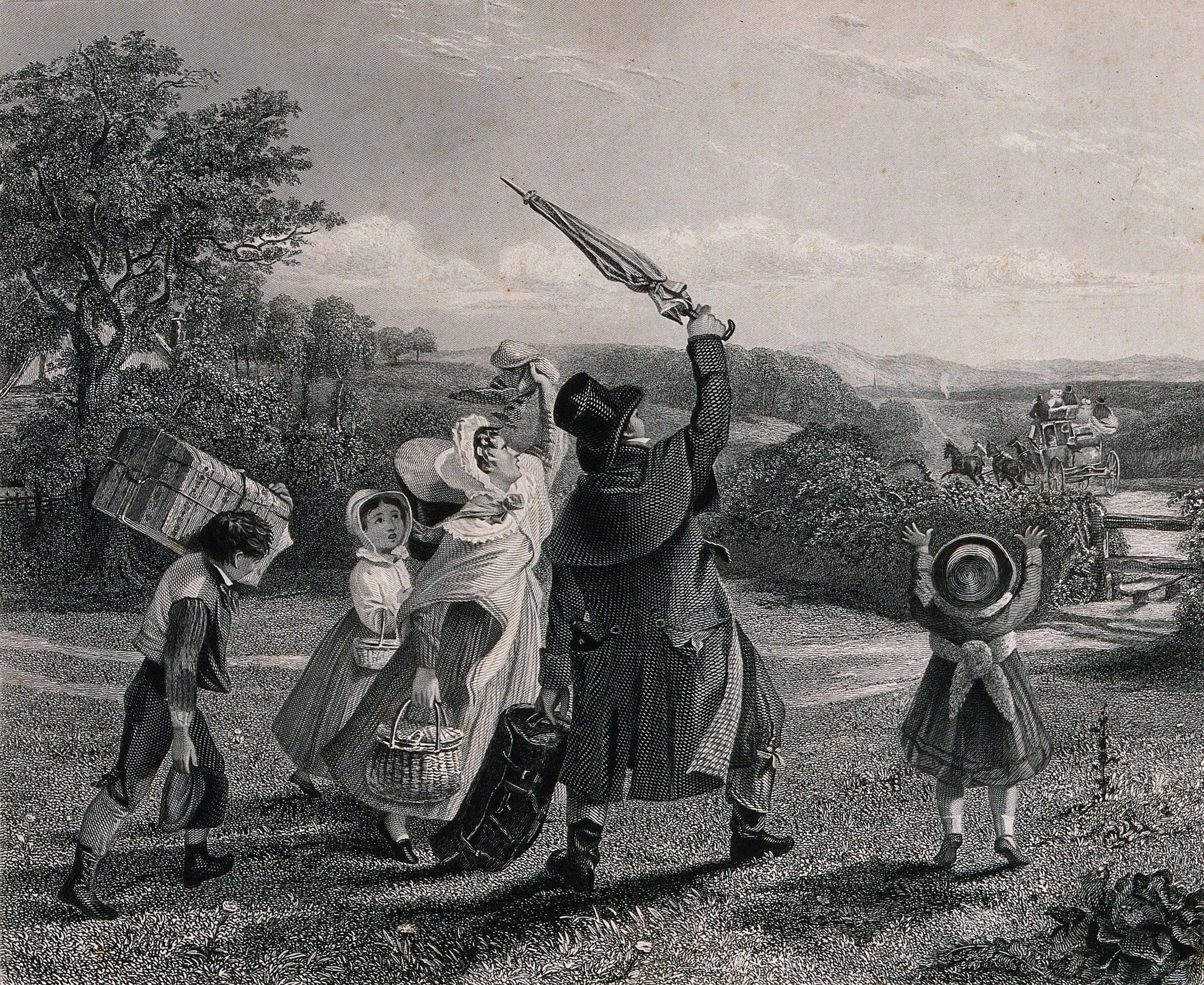
John James Chalon, Joseph Rolls. A Family Setting off on a Journey Have Missed the Coach Which Is Disappearing into the Distance. Engraving by Joseph Rolls after J.J. Chalon. 1800-1899. 1 print : engraving, image 21.3 x 25.7 cm. Wellcome Collection. https://jstor.org/stable/community.24886792.
Seeing Beyond Procrastination
Is it procrastination? Are you (by which I mean me, of course) spending writing time on reading and studying? Justifying that usage of time to yourself? In that case, it’s probably procrastination, and it’s worth taking a step back and thinking it over.
For me, talking it over with a patient friend or a rubber duck (a software engineering technique that deserves wider use) or journaling about it can be enormously helpful in figuring out how I’m feeling and why I’m avoiding writing and/or editing.
Writing is thinking: If I want to know what I think about something, or how I feel about something, or even if I’m trying to figure out what the question is, I write about it. You should try it, I bet it’ll work for you.
None of this is an argument for ditching the craft books entirely. I believe that craft books of all kinds, memoirs and how-tos alike, can be helpful at most any stage, but it’s perennially surprising to me how an educational text develops new depth and power when I return to it after spending more time practicing on my own. The best insights usually aren’t clear to me until I’ve committed enough time and effort to have my own experiences to bring to bear on the advice I’m reading.
The other side of this is that maybe the story you’re writing needs a little more time in your brain, and what looks like procrastination is actually something more like story incubation. What else can you work on while your main project is cooking?
Write Better by Writing More
I had some plot issues with the novel I’m trying to write—side characters not pulling their weight, not enough of the right kinds of challenges for the main character—and it needed some brain incubation time. While I was working out how to give my novel a chance to come together, I wasn’t doing much writing, and I missed it.
I’ve been wanting to try writing short stories and I have a pile of scraps of ideas and orphan scenes, but I hadn’t been doing anything with my ideas after the initial inspiration. I assumed I was procrastinating, but I didn’t investigate.
Then one day I was thinking about an idea I really liked, and I thought to myself that I didn’t want to work on the story just yet, because it was “too good” of an idea to squander on my current skill level. Without thinking about it, I’d been saving my ideas for when I became a better writer.
When I realized that’s what I’d been doing, I saw my anti-strategy for what it was and reminded myself that the only way to get better at writing is to write. I won’t ruin my story ideas by writing about them, regardless of whether I love the results.
Let’s go write!