Weren’t You Writing a Book?
I was and will be! But putting together a novel is a difficult for me as a newbie, and I need to build skill. What I think is happening is that I need more practice with plotting and I need to figure out how the story of the novel works. So for right now, I’m mostly letting the novel rest and spending more time on writing short stories and reading deliberately.
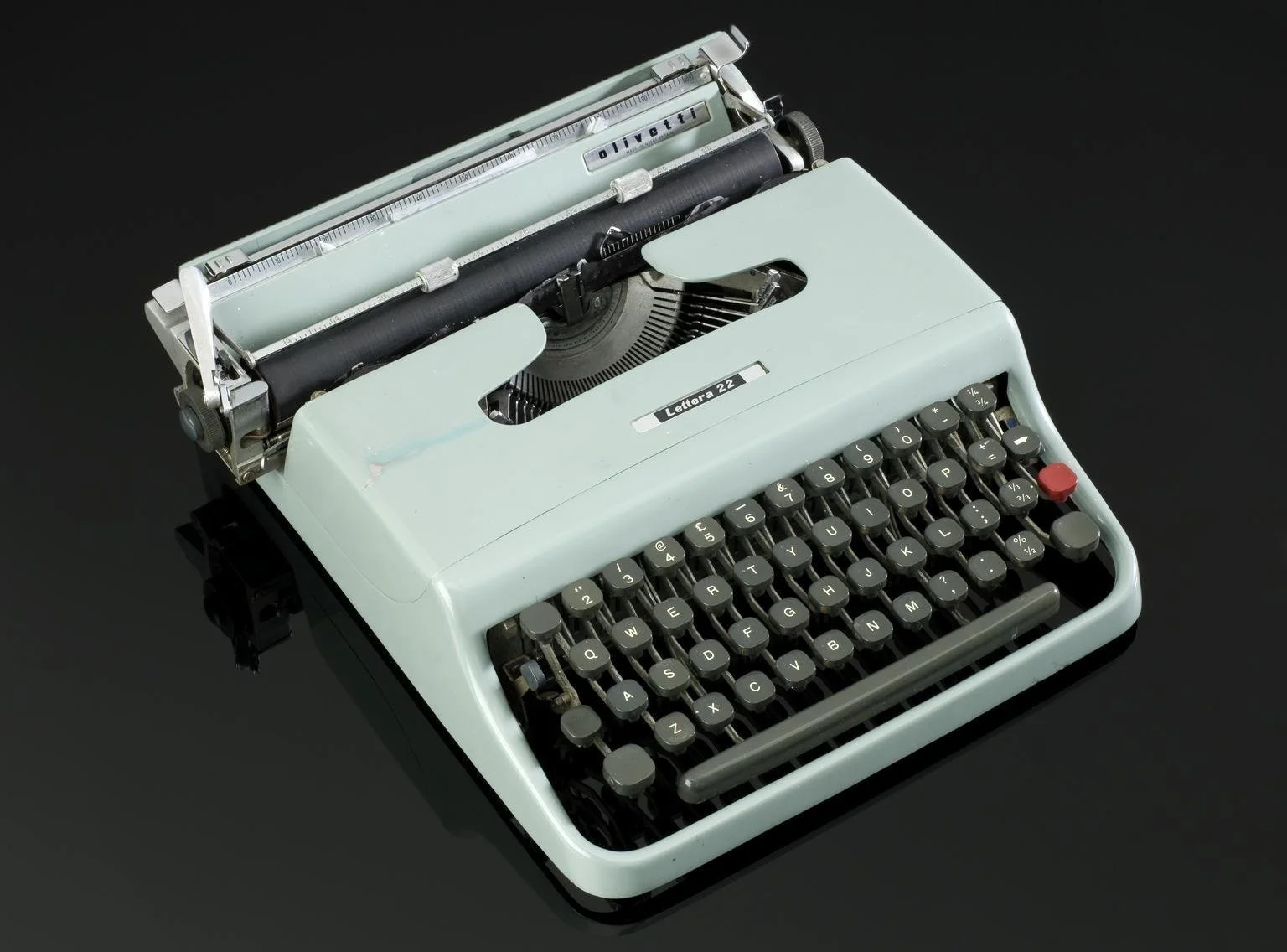
Olivetti Lettera 22 Typewriter, c. 1960. In Olivetti Lettera 22 Typewriter, c. 1960. [Co37805]. 1960. Science Museum Group Collection; Pontecorvo, L. (Eton). Open: Science Museum Group. Artstor. https://jstor.org/stable/community.26311695.
Misjudging difficulty
I feel a little embarrassed that even though I thought I had an appreciation for how much work goes into writing a novel I’d feel good about, I still underestimated it (wildly). Not the scope of it—writing the words that went into the messy first draft and a half (of around 150K or so words, many of which need to be removed) did take a long time, but I had some preparation for the long written project part of things with my dissertation.
When I started working on the dissertation in earnest, I realized that it wasn’t at all the sort of thing I had been expecting. I’d written a senior thesis as an undergrad and a master’s thesis in my grad program, so I expected the doctoral dissertation to be a longer version of a thesis.
It was not.
It was harder than anything else I’d done and no amount of writing shorter papers would’ve prepared me for the jump in difficulty that happens between thesis and dissertation in a discipline like history. (There are lots of reasons that history presents deep complexity and challenge to doctoral students in a way that is distinct from other disciplines; for a short discussion and overview of it, The Landscape of History is very good.)
Reading with Purpose
Instead of a novel’s longer cadence of getting things wrong and figuring them out, I’m getting things wrong and figuring them out in short stories. I’m jumping in and “ruining” ideas I really like with my clumsiness. To practice writing short stories, I’m doing an easier version of the Bradbury challenge, or 3/1/52 challenge (see LaRonn, Michael. “The 3/1/52 Challenge,” Writer’s Digest, January/February 2026, 34-37). The real challenge requires reading one short story, poem, and essay every day and writing one story every week for one year. In my version, I’m giving myself the weekends off. That lets me catch up when I get behind—which I do, inevitably.
I’m combining the reading part of the challenge with my weird detectives summer reading list. So far, it’s been rewarding and I’m getting more out of my reading than I have in a long time. It’s harder than it sounds like it would be to do, though, even the easier version that I’m doing.
The first week it seemed like it was going to be a breeze. Then, when things got busier, I understood. It’s fun and feels worth it, but it’s not a breeze. The thing that’s been most difficult for me is getting a story written each week. I’ve managed, barely, to get one drafted each week so far, but I haven’t been going back through and trying to give the week’s story an editing pass.
This feels like cheating, but one thing that’s been helpful is getting audiobooks of short stories and essays from my library. I listen while I’m doing chores or walking and I can stack up my reading to give myself more flexibility when life gets busier. For poetry, I’ve been using the Poetry Foundation’s website.
short Story Practice
For the short story writing, one of the suggestions LaRonn makes in his article is to use Lester Dent’s plot formula (the link is to a Writer’s Digest webinar by Michael LaRonn, which I haven’t watched. You can also search for “Lester Dent plot formula” and you’ll find lots of discussions of it). It was originally intended for a six-thousand word pulp short story. I’m trying to use it on a weird detective story that I’m drafting right now. I like it.
It seems like a helpful way to think about building a fast-paced and compelling plot, but my ideas don’t fit the plot formula’s shape very well—that might be my level of experience putting together compelling plots and not a failure of the formula, though.
Book Recommendations
Best American Science Fiction and Fantasy 2023, ed. R. F. Kuang
Such a strong collection! I enjoyed every one of them.
Exhalation, Ted Chiang
If you only read one story, read “The Great Silence” and prepare to be shaken. (You can read it for free on Electric Literature.) If you’re anything like me, “You be good. I love you,” will take on deep and devastating new meaning.
Let’s go write!